Welcome to CEB
The Committee on Evolutionary Biology (CEB)
The Committee on Evolutionary Biology (CEB) is a unique interdepartmental and inter-institutional graduate student training program dedicated to the study of Evolutionary Biology. Faculty and students in the program are engaged in interdisciplinary studies at time scales that range from single generations to the entire history of life and at organizational scales from the molecular to the global.

Spotlights
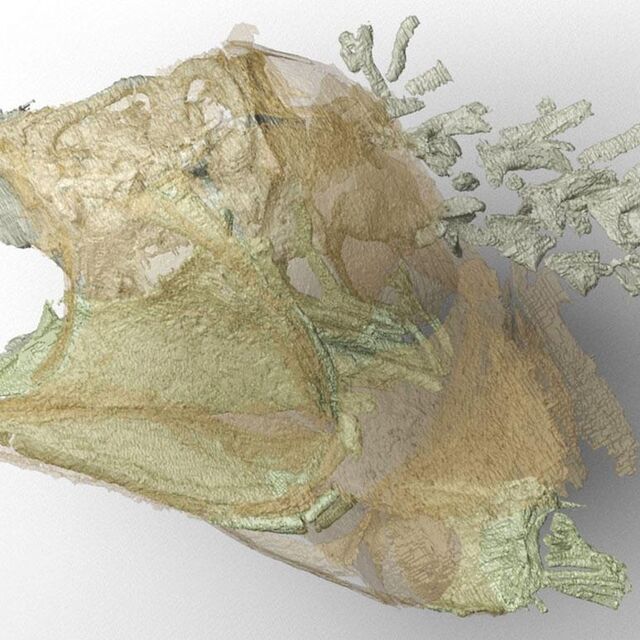
Fossil fish with preserved brain shed light on 'bottom of evolutionary tree'
Over 300 million years ago, a minnow-sized fish died and fell to the bottom of the prehistoric swamp near what is now the village of Trawden, in northwest England.
The remains of this tiny fish—known as Trawdenia planti—became fossilized, embedding proof of its existence in a layer of soapstone sandwiched between coal seams in the Burnley Coalfield. By some combination of marine chemistry, mineral composition of the seafloor, timing and luck, not only was the bony skeleton of this fish preserved, but so too were the soft neural tissues of its brain.
The fossil was unearthed in a coal seam by Trawden more than a century ago, but its secrets would take modern imaging to reveal.
A new study published in the Proceedings of the National Academy of Sciences (PNAS) by paleontologists at the University of Chicago describes this extraordinary preservation of an early ray-finned fish brain. Using CT scans of the skull and preserved soft tissues, the researchers show how the brain fit snugly inside, unlike other fossil brains that appear too small for the interior brain case. This means the inside of fossilized skulls can serve as a reliable proxy for brain size and shape of such fishes even when brain tissues are not well preserved.
“Soft tissue preservation, in general, is not common in the fossil record, and usually what gets preserved are things like skin or muscles. It's quite rare for neural tissues to be preserved at all because they decay so quickly,” said Abigail Caron, Evolutionary Biology PhD’25, lead author of the study. “So, the importance of this specimen is that we can now study brain evolution in similar fossils where we only have the bony parts or the infill.”
Read the full story by Matt Wood originally published July 2, 2026.